Mini Excavator Size Guide: How to Choose the Right Machine for Your Property
Every week, the same question pops up on equipment forums: “What size excavator should I buy?” The advice is usually a chaotic mix of "go big or go home" and "smaller is better." After consulting with dozens of operators and logging hours on a RIPPA R15, I’ve realized that guessing is a recipe for regret. Instead of following slogans, ask yourself these five critical questions to find your perfect match.
1. What is Your Narrowest Access Point?
This is the "deal-breaker" question. If the machine can’t get to the backyard, its power doesn't matter.
Under 36 inches (914 mm): You are limited to the RIPPA R10 (fixed at 900 mm) or the R13 (telescopes down to 950 mm—tight, but often doable with a little wiggle room).
40 inches (1000 mm) or wider: The R15 becomes an option, telescoping down to 980 mm.
44 inches+: You can step up to the high-performance R18 (telescopes to 1,100 mm).
Pro Tip: Don't just measure the gate; check for low-hanging eaves or AC units that might block the path.
2. What is Your "Peak" Task?
Don’t buy for your easiest job; buy for the hardest one.
| Task Intensity | Examples | Recommended Models | Digging Force |
| Light | Gardening, small trenches, planting | R10, R13 | 9–10 kN |
| Medium | Driveway repair, stumps <12", drainage | R15 (The Sweet Spot) | 10.4 kN |
| Heavy | Large stumps, pond digging, heavy clay | R18, R22 | 15–22.5 kN |
| Professional | Commercial foundations, land clearing | R57 | 45 kN |
3. How Deep Do You Really Need to Dig?
A common mistake is buying a machine that matches your required depth exactly. For comfortable operation and clean trench bottoms, you want a "buffer" of at least 6–12 inches.
R10 (2.15 m / 85"): Perfect for standard garden trenches and utility lines.
R15 (2.5 m / 98"): The homeowner standard for small ponds and moderate footings.
R18/R22 (2.9 m / 114"): Deep enough for almost any residential project, including large septic repairs.
R57 (4.1 m / 161"): Purely commercial grade.
4. How Will You Transport the Machine?
The weight of the excavator dictates what kind of truck and trailer you need.
Under 1,500 kg (R10, R13): Can be hauled by a standard half-ton pickup with a single-axle trailer.
1,500 – 2,200 kg (R15, R18): Requires a tandem-axle trailer and ideally a 3/4-ton truck.
Over 2,200 kg (R22+): You’re entering heavy-duty towing territory (one-ton trucks or commercial delivery).
Alternative: If you plan to keep the machine on-site for years, don't buy a trailer. Pay for a one-time professional delivery and save thousands in equipment costs.
5. What is Your Experience Level?
Power is a double-edged sword.
Beginners: Start with the R10 or R13. They are forgiving, less intimidating, and easier to master.
Intermediate: The R15 is the ideal entry point. It offers "real" power without being overwhelming.
Experienced: Go for the R18 or R22. You’ll appreciate the hydraulic speed and breakout force.
| Model | Weight | Dig Depth | Min Width | Best For |
| R10 | 1,000 kg | 2.15 m | 900 mm | Tight gates & beginners |
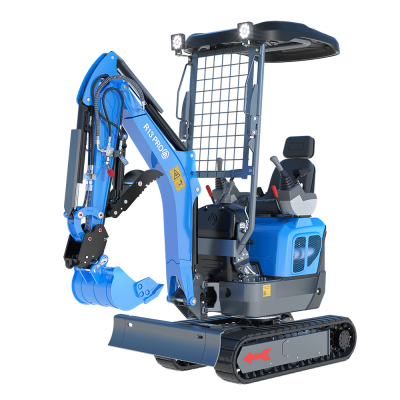
| R13 | 1,300 kg | 2.4 m | 950 mm | Zero tail swing & narrow paths |
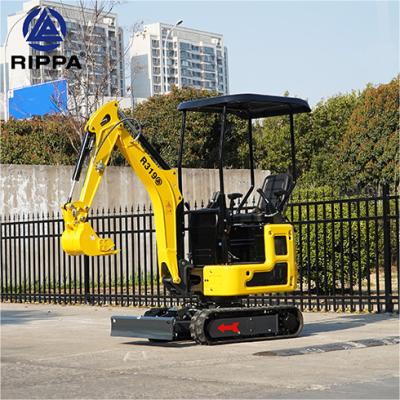
| R15 | 1,500 kg | 2.5 m | 980 mm | General homeowner use |
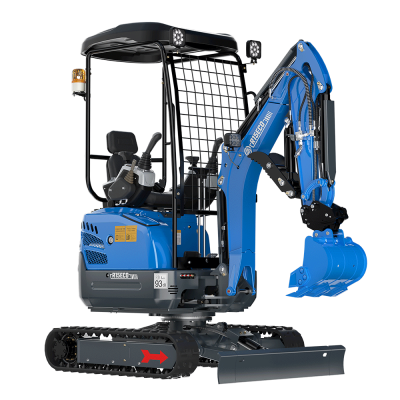
| R18 | 1,800 kg | 2.9 m | 1,100 mm | Stumps & heavy clearing |
| R22 | 2,200 kg | 2.9 m | 1,300 mm | Pools & major foundations |
Final Advice: Start Where You Are
Remember: Excavators hold their value remarkably well. Many owners start with a smaller R10, finish their initial landscaping, and eventually trade up to an R18 once they realize how much more they can do.