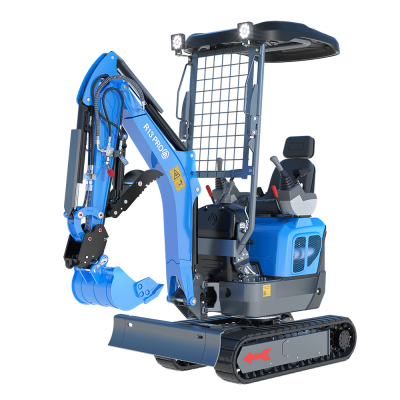
How to Choose the Right RIPPA Mini Excavator: A Simple Model Guide for Homeowners, Farmers, and Contractors
Meta Description
Compare RIPPA mini excavator models including R06-1 ECO, R10-6 ECO, R13-4 PRO, R15-5 ECO, R18-5 PRO, R22-3 PRO, R32-4 PRO, and R57-2 PRO. Learn how to choose the right machine based on job type, attachments, work space, and long-term value.
One chart can save you from buying the wrong excavator
For many buyers in North America and Europe, the hardest part of buying a mini excavator is not deciding whether to buy one. It is deciding which model actually fits the work.
At first glance, compact excavators can look similar. But in real-world use, the differences are significant:
digging capability, attachment compatibility, transport convenience, jobsite access, operator comfort, and return on investment all vary from model to model.
That is why the smartest way to choose a RIPPA mini excavator is not to start with price. Start with the job.
Here are the four questions every buyer should ask first:
1. What kind of work will the machine do most often?
Backyard trenching, pool digging, tree planting, drainage work, farm maintenance, fencing, foundation prep, or light commercial work?
2. Which attachments will you actually use?
A machine is only as useful as the tools it can run well. Buckets, augers, grapples, breakers, rakes, and tilting buckets can make a huge difference in productivity.
3. How tight is your work space?
This matters more than many first-time buyers expect. In residential markets, side-yard access, gate clearance, turf protection, and trailer convenience are often major decision points.
4. Are you buying for personal property use or for business use?
Homeowners often care most about simplicity, compact size, and ease of ownership. Contractors care more about uptime, versatility, jobsite performance, and long-term payback.
How RIPPA models can be grouped
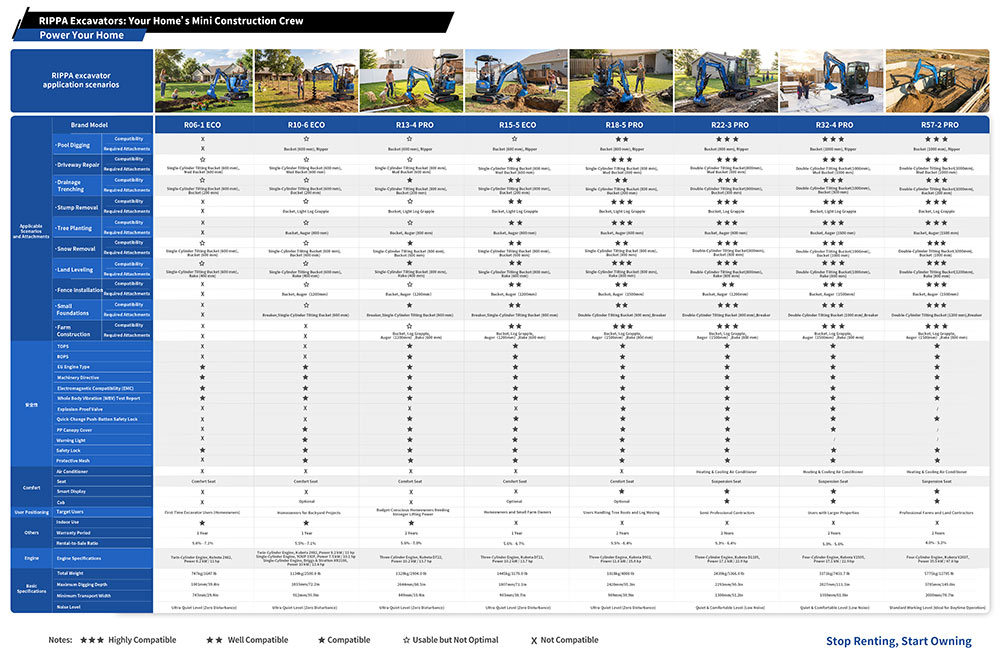
Based on the RIPPA comparison chart, these models can be understood in four practical buying categories.
1. Entry-level light-duty machines: R06-1 ECO / R10-6 ECO
These models are ideal for:
● homeowners
● backyard projects
● light landscaping
● shallow trenching
● small repair jobs
● buyers who prioritize easy transport and storage
Who are they best for?
If a customer is new to excavators and mainly working on home projects, garden improvements, light digging, and occasional property maintenance, these are often the easiest models to recommend.Buying tip:
● R06-1 ECO fits very light-duty tasks and tighter spaces
● R10-6 ECO is often the better “first machine” because it offers a more balanced mix of agility and usable capability
Why these work well in Western markets:
They align well with the needs of homeowners, DIY landowners, and buyers looking for a compact machine that is easy to tow, easy to learn, and practical for small properties.
2. The sweet spot for property owners and light commercial users: R13-4 PRO / R15-5 ECO / R18-5 PRO
This is the category many buyers spend the most time comparing, and for good reason. It often delivers the best balance of power, versatility, and ownership value.
These models are well suited for:
● drainage trenching
● tree planting
● land leveling
● fencing work
● snow-related cleanup
● farm and acreage maintenance
● multi-attachment jobs
Why this category matters so much:
Most buyers do not need a machine for only one task. They need one machine that can trench one day, level ground the next day, and handle attachments across different seasons.That is where this range becomes attractive.
Buying tip:
● R13-4 PRO works well for budget-conscious buyers who want more capability than a very small entry model
● R15-5 ECO is a strong all-around fit for homeowners and small property users
● R18-5 PRO makes more sense when the buyer expects heavier attachment use or more frequent work hours
Typical buyer profiles in the U.S. and Europe:
● acreage owners
● hobby farmers
● landscaping customers
● small property maintenance businesses
● light-duty contractors
3. Higher-output machines for serious work: R22-3 PRO / R32-4 PRO
If the machine is expected to do more than occasional work, this is where many professional buyers start paying close attention.
These models are a stronger fit for:
● frequent trenching and earthmoving
● small commercial jobs
● higher attachment usage
● contractors who value efficiency and stability
● dealers targeting semi-professional and contractor customers
Why contractors look here:
● Professional buyers are not just paying for a machine that runs. They are paying for:more work completed per day
● stronger jobsite performance
● better attachment support
● more dependable business value
Buying tip:
● R22-3 PRO is a logical step up for customers moving beyond homeowner-level use
● R32-4 PRO is better for buyers who need more digging depth, more reach, and broader jobsite capability
4. Heavy-duty professional solution: R57-2 PRO
For customers focused on:
● farm construction
● more advanced foundation work
● heavier digging jobs
● longer daily operating hours
● larger project capacity
the R57-2 PRO stands out as the professional-grade option.
These buyers are usually less focused on the lowest purchase price and more focused on:
● daily output
● labor savings
● reduced outsourcing
● heavier job coverage
● long-term machine value
What should buyers prioritize by application?
Residential and backyard projects
Focus on:
● compact size
● transport simplicity
● ease of operation
● ground friendliness
● practical attachment support
Best starting points: R06-1 ECO, R10-6 ECO, R13-4 PRO
Farms and large property maintenance
Focus on:
● versatility
● trenching and planting efficiency
● attachment flexibility
● everyday durability
Best starting points: R15-5 ECO, R18-5 PRO, R22-3 PRO
Landscaping crews and small contractors
Focus on:
● work rate
● multi-task capability
● digging depth
● compatibility with breakers, augers, grapples, and specialty attachments
Best starting points: R18-5 PRO, R22-3 PRO, R32-4 PRO
Professional and heavy-use operations
Focus on:
● structural strength
● power reserve
● stability under load
● operator comfort over long hours
● return on investment
Best fit: R57-2 PRO
Five mistakes buyers often make when shopping for a mini excavator
1. Looking only at machine size, not attachment capability
In real work, the right attachment setup often matters just as much as the base machine.
2. Looking only at upfront price
Ownership cost also includes transport, storage, maintenance, service access, and usable flexibility over time.
3. Buying only for today’s project
A lot of buyers start with backyard jobs, then move into drainage, fencing, grading, or paid work. Choosing too small can become expensive later.
4. Ignoring operator comfort
For occasional use, comfort may seem secondary. For frequent use, seat quality, controls, visibility, and operating environment directly affect productivity.
5. Underestimating the value of printed comparison materials
For dealers, a visual model guide is not just a brochure. It is a sales tool that helps customers understand differences fast and make decisions with more confidence.
Why dealers should print this chart and display it in-store
This RIPPA chart works well because it turns a complicated buying decision into a simple visual conversation.
It helps dealers:
● show model positioning at a glance
● shift the conversation from raw specs to real applications
● shorten the sales cycle
● guide buyers toward the right machine faster
● support machine displays, attachment demos, and quote discussions
For dealerships, this kind of printed material is especially effective in:
● showroom walls
● reception areas
● attachment sections
● sales desks
● trade show booths
In Western markets, buyers respond well to comparison tools that help them self-educate before talking numbers. A chart like this makes that easier.
Final takeaway
The best way to choose a RIPPA mini excavator is simple:
Start with the job, then the attachments, then the work space, and only then the budget.
For most buyers:
● go with R06-1 ECO / R10-6 ECO for lightweight entry use
● choose R13-4 PRO / R15-5 ECO / R18-5 PRO for balanced versatility
● move to R22-3 PRO / R32-4 PRO for more professional output
● consider R57-2 PRO for heavy-duty commercial needs
And for dealers, this is more than a comparison chart. It is a practical in-store sales asset worth printing and displaying.